Frank DeMartin, general manager of Mitsubishi Digital Electronics America, was nice enough to talk a little laser TV with us just before the unveiling of the new laser TV -- we're not exaggerating about the "little" part. While it all sounds fantastic, we were disappointed that he wasn't willing to even begin to satisfy our unlimited thirst for technical details. But he was confident that a laser TV could provide the ultimate in picture quality because "laser has the ability to hit color points that no other technology can." We understand his desire not to spill trade secrets, but any technical information beyond, "it's the best" would've been better than nothing. So while we don't know how the TV works, we do know that the principal makes sense; lasers offer the purest form of light, while at the same time use less power than other light sources. The problem of course is that the competition in the HDTV market is a fast moving target, and with the delays Mitsubishi has been dealing with, we wonder how competitively priced this new technology will be -- though Frank assured us that Mitsubishi's dominance in the red laser market will help . Frank says, "it'll be competitive with flat panel prices," and that's great and all, but price isn't the only factor needed to compete against flat panels, people like thin TVs and the laser TV isn't thin -- it's about as thin as a DLP. But regardless of being the same price, Mitsu thinks the superior picture quality will trump thin because "people want it flat, but they want it large too." Either way, we'll have to wait until some unknown time this year to see if the laser TV can live up to the hype, but with what we know right now, we're not sold just yet. -Ben Drawbaugh, engadget
Collection of Laser TV news, updates, reviews. What is Laser TV? Is Laser TV can win against LCD, Plasma, OLED? Everything about Laser TV
Thursday, April 24, 2008
Will laser TVs be the next big thing?
Frank DeMartin, general manager of Mitsubishi Digital Electronics America, was nice enough to talk a little laser TV with us just before the unveiling of the new laser TV -- we're not exaggerating about the "little" part. While it all sounds fantastic, we were disappointed that he wasn't willing to even begin to satisfy our unlimited thirst for technical details. But he was confident that a laser TV could provide the ultimate in picture quality because "laser has the ability to hit color points that no other technology can." We understand his desire not to spill trade secrets, but any technical information beyond, "it's the best" would've been better than nothing. So while we don't know how the TV works, we do know that the principal makes sense; lasers offer the purest form of light, while at the same time use less power than other light sources. The problem of course is that the competition in the HDTV market is a fast moving target, and with the delays Mitsubishi has been dealing with, we wonder how competitively priced this new technology will be -- though Frank assured us that Mitsubishi's dominance in the red laser market will help . Frank says, "it'll be competitive with flat panel prices," and that's great and all, but price isn't the only factor needed to compete against flat panels, people like thin TVs and the laser TV isn't thin -- it's about as thin as a DLP. But regardless of being the same price, Mitsu thinks the superior picture quality will trump thin because "people want it flat, but they want it large too." Either way, we'll have to wait until some unknown time this year to see if the laser TV can live up to the hype, but with what we know right now, we're not sold just yet. -Ben Drawbaugh, engadget
Thursday, April 17, 2008
Make Way for LaserTV
Check out LaserTv technology from Novalux. According to RealTechNews:
Plasma was king until LCD got bigger and better. And just when you thought you could settle down in front of a huge LCD screen and enjoy some high-def peace of mind comes LaserTV. Developed by Novalux, LaserTV has this little calling card: it costs 50% less to produce, has double the color range, and uses 75% less power.
The article continues:
So here is where LaserTV fits, in the big picture (so to speak.) LaserTV is a projection technology, so if you like micro-thin flat panels, this is not for you. The technology replaces the spinning UHP lamp in the back of projection DLP and LCD TVs with laser-beaming hardware. The lasers are faster and use less power, and they create a picture that side by side, has blown away the best plasma, projection and LCDs sets currently on the market.
So just like LCOS, if you're looking for a sleek flat-screen then LaserTV probably isn't for you. If you can handle a larger projection TV that's affordable, the LaserTv may be right down your alley. -tvsnob
Friday, April 11, 2008
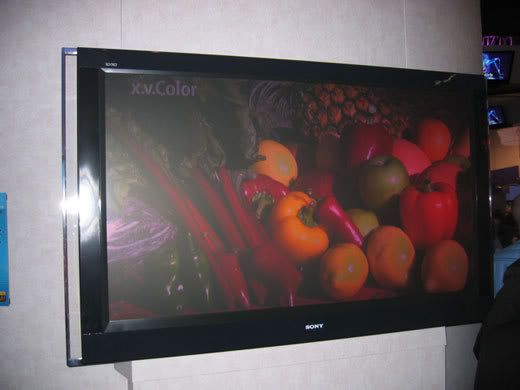
Sony displayed a laser TV at CES
LCD and plasma may be all the rage when it comes to current HDTV implementations, but next year should see the emergence of laser TV—sort of an offshoot of DLP technology—, which has double the color range and costs manufacturers a lot less to produce. For us that means lower prices, or at least it should. From a performance standpoint, laser TV pretty much makes plasma and LCD look silly, but the two oldies still have one thing going for them: size. Since laser TV is a projection technology, you’re not likely to be able to hang it up on the wall all that easily.
Sony displayed a laser TV at CES this year (yup, that’s it up there) and was said to be the best looking TV in its arsenal.
-crunchgear
Sunday, April 6, 2008
Mitsubishi's Laser HDTV is named: LASERVUE?
News about Mitsubishi's laser TV may be short on specs and specifics, but it's already got plenty of naming options. Following up on earlier nomenclature rumors pointing towards LAZRTV, an anonymous tipster gave the heads up of yet another filing, dated January 24, attributed to Mitsubishi and attorney Ronald L. Taylor:
LASERVUE. As far as we know, Motorola hasn't beaten them to the punch on this one, so maybe it will stick. According to the tip, an official announcement could be due the first week of April, so at least we'll have something to look forward to when our NCAA tournament brackets have long been torn up and discarded.
-engadgetHD
Monday, March 31, 2008
65 inches OLED Killer from Mitsubishi
Laser TV will kill OLED before it ever really takes off. Mitsubishi has a working experimental 65-inch model. At ten inches thick, it is a fatty compared to the ultra slim OLED monitors that are starting to hit the market, but it is 65-inches, which puts their puny size to shame. New technology in the pipeline, namely the "super wide angular optical engine" promises to get the thickness down to acceptable levels by the time the first commercial models roll out.
With twice the color spectrum, twice the contrast ratio and the capability of displaying three-dimensional images, Mitsubishi looks to have a real winner on its hands. It is possible that we will start seeing the first commercial models as early as this year. If that is the case, OLED might never make it out of smaller screens.
Monday, March 24, 2008
Laser TV "plasma killer" Delayed
THE launch of the device which was supposed to sweep the plasma television off the shelves this Christmas, the Laser TV, has been delayed.
Mitsubishi Digital Electronics, has told the television industry to expect a major laser TV announcement at a US trade show in January. However it will not say how long it will take before the technology goes on sale afterwards.
Either way the first laser TV was supposed to be in the shops in time for this Christmas.
Laser TVs can produce twice the range of colours of current flat panel models while being thinner, lighter and use less juice.
It was believed that the technology would take over from plasma at the 40 inch screen size and above leaving the smaller screens to LCDs.
The delay appears to be at the production side of the release rather than anything to do with the television technology.
Mitsubishi Digital Electronics, has told the television industry to expect a major laser TV announcement at a US trade show in January. However it will not say how long it will take before the technology goes on sale afterwards.
Either way the first laser TV was supposed to be in the shops in time for this Christmas.
Laser TVs can produce twice the range of colours of current flat panel models while being thinner, lighter and use less juice.
It was believed that the technology would take over from plasma at the 40 inch screen size and above leaving the smaller screens to LCDs.
The delay appears to be at the production side of the release rather than anything to do with the television technology.
Friday, March 21, 2008
Laser TV unveiled
Read this article from Adam Bennett
IT'S being hailed by its developers as the next revolution in visual technology - a laser television that will make plasma screens obsolete.
Soon-to-be-listed Australian company Arasor International and its US partner Novalux unveiled what they claimed to be the world's first laser television in Sydney today, with a pitch that it would be half the price, twice as good, and use a quarter of the electricity of conventional plasma and LCD TVs.
Manufacturing company Arasor produces the unique optoelectronic chip central to the laser projection device being developed by Silicon Valley-based Novalux, which is being used by a number of television manufacturers.
And displayed beside a conventional 50 inch plasma TV this afternoon, the Mitsubishi-built prototype does appear brighter and clearer than its “older” rival.
With a worldwide launch date scheduled for Christmas 2007, under recognisable brands like Mitsubishi and Samsung, Novalux chief executive Jean-Michel Pelaprat is so bold as to predict the death of plasma.
“If you look at any screen today, the colour content is roughly about 30-35 per cent of what the eye can see,” he said.
“But for the very first time with a laser TV we'll be able to see 90 per cent of what the eye can see.
“All of a sudden what you see is a lifelike image on display.”
Combine that with energy efficiency, price advantage and the fact that the laser TVs will be half the weight and depth of plasma TVS, and Mr Pelaprat says “plasma is now something of the past”.
Mr Pelaprat predicted LCD TVs would come to dominate the market below 40 inches, and laser television the market above that screen size, displacing plasma.
The optoelectronic chip-laser technology won't be confined to TVs.
The technology is also being trialled in mobile phones, where it will be used to project images onto any surface, and in home theatres and cinemas.
IT'S being hailed by its developers as the next revolution in visual technology - a laser television that will make plasma screens obsolete.
Soon-to-be-listed Australian company Arasor International and its US partner Novalux unveiled what they claimed to be the world's first laser television in Sydney today, with a pitch that it would be half the price, twice as good, and use a quarter of the electricity of conventional plasma and LCD TVs.
Manufacturing company Arasor produces the unique optoelectronic chip central to the laser projection device being developed by Silicon Valley-based Novalux, which is being used by a number of television manufacturers.
And displayed beside a conventional 50 inch plasma TV this afternoon, the Mitsubishi-built prototype does appear brighter and clearer than its “older” rival.
With a worldwide launch date scheduled for Christmas 2007, under recognisable brands like Mitsubishi and Samsung, Novalux chief executive Jean-Michel Pelaprat is so bold as to predict the death of plasma.
“If you look at any screen today, the colour content is roughly about 30-35 per cent of what the eye can see,” he said.
“But for the very first time with a laser TV we'll be able to see 90 per cent of what the eye can see.
“All of a sudden what you see is a lifelike image on display.”
Combine that with energy efficiency, price advantage and the fact that the laser TVs will be half the weight and depth of plasma TVS, and Mr Pelaprat says “plasma is now something of the past”.
Mr Pelaprat predicted LCD TVs would come to dominate the market below 40 inches, and laser television the market above that screen size, displacing plasma.
The optoelectronic chip-laser technology won't be confined to TVs.
The technology is also being trialled in mobile phones, where it will be used to project images onto any surface, and in home theatres and cinemas.
Subscribe to:
Posts (Atom)